
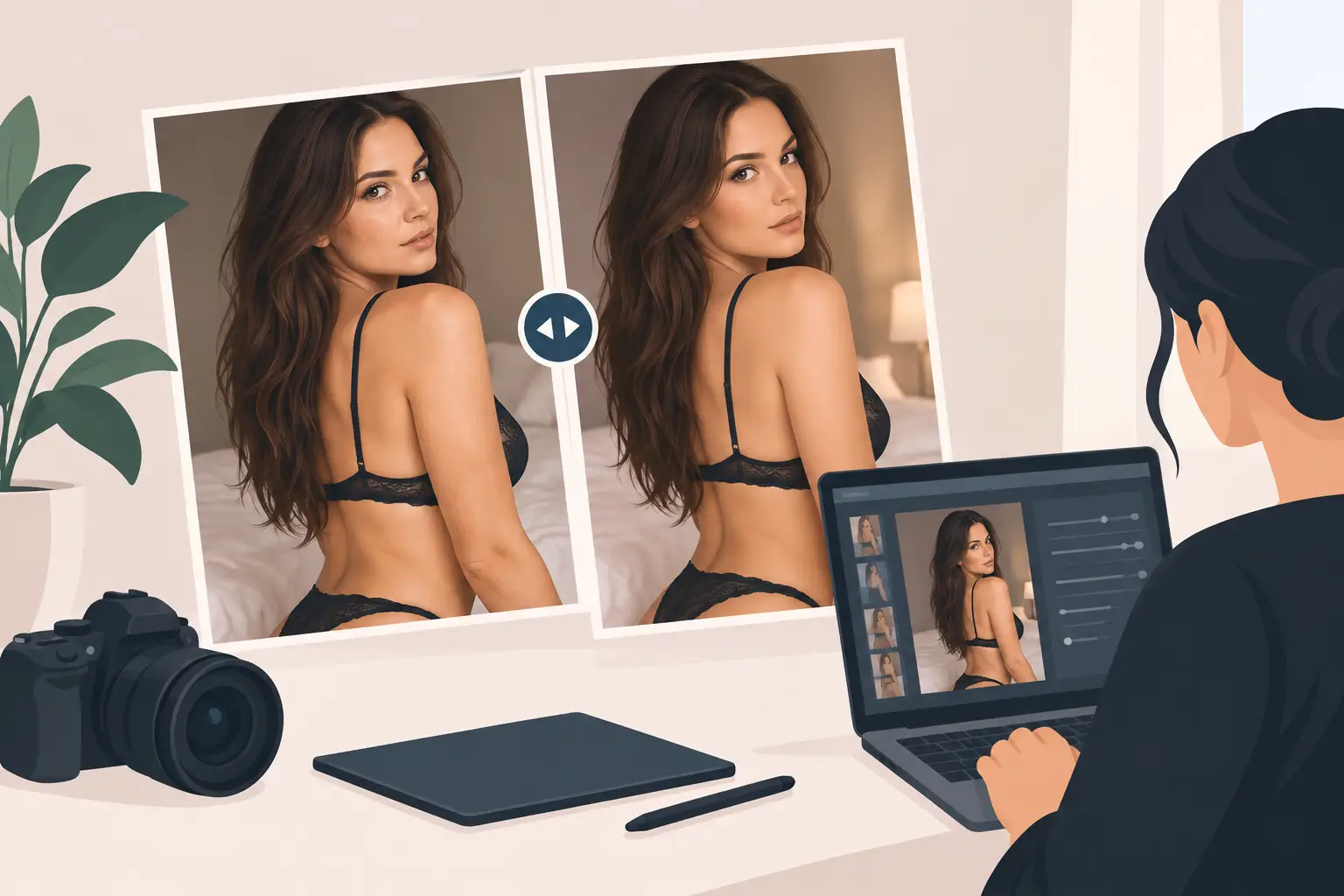
A boudoir portrait should feel like you on an exceptional day: poised, beautifully lit, and fully present in your own confidence. So, are boudoir photos professionally retouched? At a luxury studio, yes. Thoughtful professional retouching is part of the finished portrait experience, but its purpose is not to erase the woman in the image. Its purpose is to refine the photograph so your essence, strength, and beauty are what command attention.
For many women, this question carries more weight than a technical curiosity. It may come with concerns about looking unlike yourself, pressure to appear flawless, or uncertainty about what will be visible in an intimate portrait. The right answer is not simply that retouching happens. It is that the process should be intentional, skillful, and guided by your comfort.
Are boudoir photos professionally retouched? Yes, with intention
Professional retouching is the final stage of a carefully crafted image. It works alongside expert posing, styling, hair and makeup, and flattering light. When those elements are done well in camera, editing becomes a sophisticated polish rather than an attempt to rescue the photograph.
A finished boudoir portrait may receive adjustments to color, exposure, contrast, and skin tone so it has a luminous, cohesive quality. An editor may soften a temporary blemish, reduce a distracting under-eye shadow, tame flyaway hairs, or refine a wrinkle in fabric that pulls attention away from your expression. Details in the background, wardrobe, or set can also be cleaned up to preserve the elegance of the final piece.
These refinements are standard because photography captures every small visual detail, including ones the eye would ordinarily overlook in person. A camera can emphasize a crease created by a pose, a momentary mark on the skin, or a reflection that does not belong in a finished portrait. Professional editing helps the image reflect how the session felt: elevated, composed, and beautiful.
What refined boudoir retouching should preserve
The best retouching is often difficult to identify. You see an exquisite portrait, not a collection of editing techniques. Skin still has texture. Your facial features remain yours. Your body retains its natural shape, presence, and individuality.
That distinction matters. Over-retouching can make skin appear waxy, remove the character from a smile, or alter proportions so dramatically that the finished image no longer feels personal. An image may look technically smooth, yet emotionally distant. Boudoir photography deserves more than a generic version of perfection.
At Franklin Photography Studios, the goal is to create imagery that feels polished and artful while honoring the woman who stepped in front of the camera. A striking portrait is not built on the idea that you need to be changed. It is built through direction, light, expression, and a refined visual finish that allows you to see yourself with fresh appreciation.
Temporary details versus defining features
A useful way to think about retouching is to separate temporary details from the features that tell your story. A temporary breakout, a stray hair across the face, or a pressure mark from clothing may not represent how you want to remember this season. Many clients prefer those details softened or removed.
Other features can be deeply personal. Freckles, laugh lines, scars, beauty marks, tattoos, and natural body texture are not automatically flaws. They are part of your appearance and, sometimes, part of the reason a portrait feels honest and powerful. Whether to retain, soften, or remove them is a personal decision, not a rule imposed by the studio.
Body shaping is a conversation, not an assumption
Body shaping is one of the most sensitive aspects of boudoir retouching. A professional photographer uses posing, camera angles, wardrobe selection, and lighting first because these methods create a naturally flattering result without changing who you are.
Subtle refinements may be available when requested, but they should never be assumed. Some clients want a small adjustment to a garment line or a temporary mark; others want images that reflect every detail exactly as it appeared that day. Both preferences are valid. The key is clarity before editing begins.
Why the photography process matters before retouching
Retouching should support excellent photography, not replace it. This is especially meaningful in boudoir, where confidence is often shaped as much by the experience as by the final images.
Professional hair and makeup can create camera-ready definition while still looking like you. Guided posing helps you understand what to do with your hands, where to place your gaze, and how to move through each pose without feeling self-conscious. Careful lighting can highlight your eyes, create graceful contours, and bring softness to skin before a single image reaches the editing stage.
A full-service session also gives you room to settle into the experience. You do not need to arrive knowing how to pose or how to create a certain expression. You simply need a willingness to be guided. That support often changes the way clients see themselves long before they view their final portraits.
How to talk about your retouching preferences
You do not need technical language to communicate what feels right. A trusted photographer should make space for an honest conversation about your goals, your concerns, and the details that matter most to you.
Start by sharing how you want your images to feel. Perhaps you want timeless and natural, glamorous and editorial, or softly romantic. Then name anything that may make you feel vulnerable. You can say that you love your freckles, would prefer a temporary blemish removed, want a tattoo visible, or feel uncertain about a particular area of your body. These details help your photographer approach the session and the final edits with care.
It is also helpful to ask what is included in the studio’s standard retouching process and whether additional requests can be accommodated. There is a practical trade-off here: highly detailed custom edits require additional time and may affect delivery schedules or image pricing. Clear expectations prevent disappointment and ensure the investment reflects the level of artistry you want.
Questions worth asking before your session
Before booking, ask to see examples of the studio’s finished work and look closely at the editing style. Do faces look expressive? Does skin look believable? Are the images consistent in color, tone, and quality? A beautiful portfolio can tell you more than a promise of “full retouching.”
You may also ask how the studio handles privacy, how image selections are made, and when you will be able to communicate editing preferences. Boudoir is personal. You deserve a process that feels discreet, respectful, and aligned with your boundaries from the first consultation to the final artwork.
The goal is recognition, not reinvention
A professionally retouched boudoir photograph should invite a powerful reaction: “That is me.” Not a stranger with your face, and not a diminished version of you shaped by someone else’s standard of beauty. You should recognize your features, your spirit, and the confidence that emerged when you allowed yourself to be seen.
The most meaningful portraits do not ask you to earn your place in front of the camera by becoming flawless first. They honor the woman you are now, then present her with exceptional care. Choose a photographer whose artistry makes you feel elevated without ever making you feel erased.
Leave a Reply