
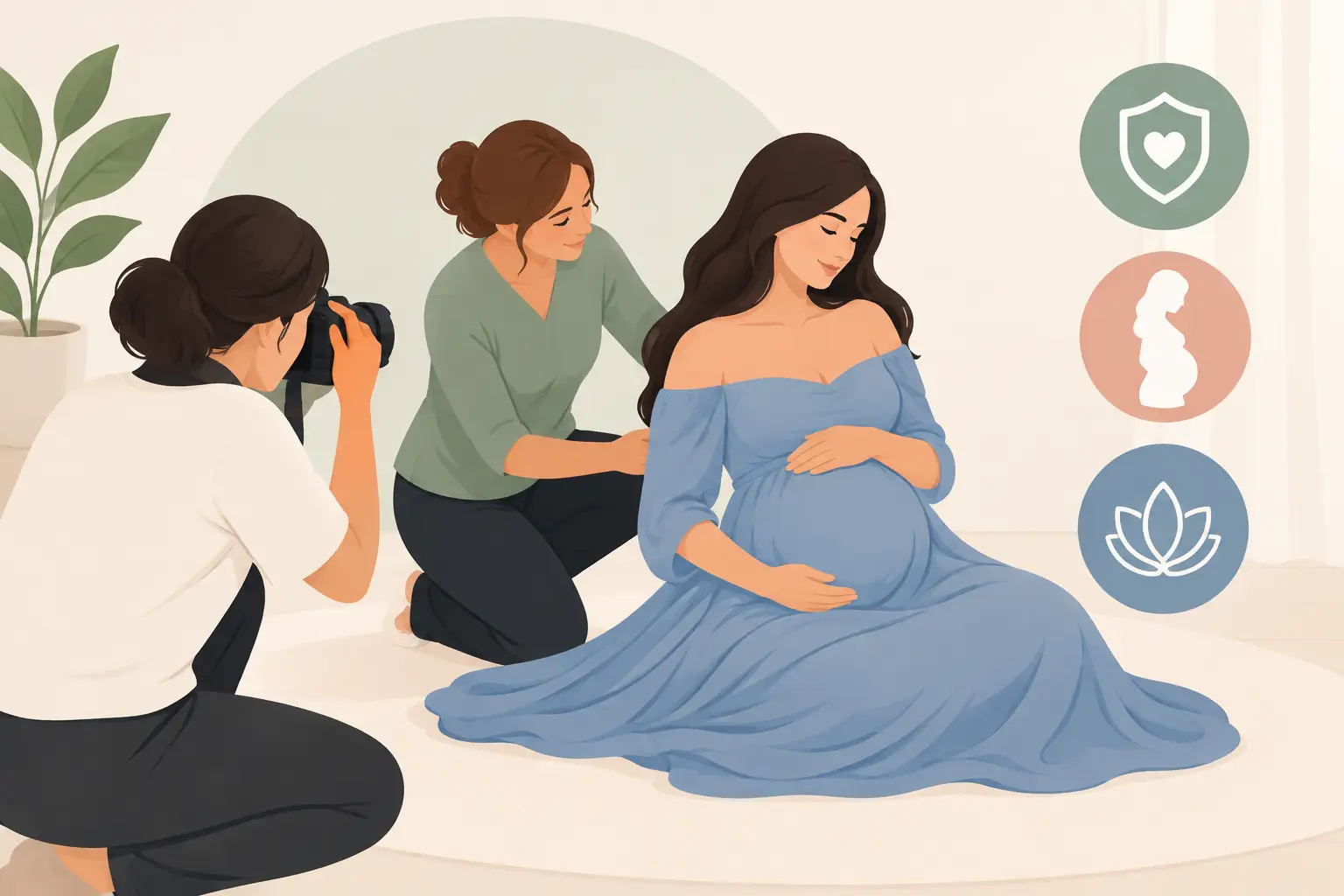
A maternity portrait should feel like a celebration, not an endurance test. Thoughtful maternity pose safety creates the conditions for images that feel serene, sculptural, and unmistakably you, while respecting what your body needs on the day of your session. The most beautiful photographs are never worth discomfort. They are created through careful direction, attentive pacing, and a studio environment where you feel genuinely cared for.
Pregnancy changes balance, energy, mobility, and comfort from one week to the next. A pose that felt easy yesterday may feel entirely different today. That is why a luxury maternity experience is not about asking you to hold a dramatic position for the camera. It is about shaping a session around your body, your energy, and the story you want to treasure for a lifetime.
What Maternity Pose Safety Looks Like in Practice
Safe posing begins before the first photograph. Your photographer should ask how far along you are, whether your provider has given you any movement restrictions, and how you are feeling that day. This is not clinical intake. It is considerate preparation that allows the creative direction to be personal rather than prescriptive.
During the session, expert posing is built in small adjustments. A slight turn of the shoulders, a softened knee, a hand placed beneath the bump, or a shift of weight can create a graceful silhouette without asking your body to work harder than it should. A skilled photographer watches for signs that a position is becoming tiring and offers a reset before you need to ask.
Comfort is also visual. When you feel steady, supported, and unhurried, your expression relaxes. Your hands become natural. Your posture has elegance without strain. This is where technical mastery and a reassuring experience meet: the pose flatters you because it honors you.
Choose Stability Before Drama
A well-directed maternity portrait can look editorial without relying on risky or demanding positions. Standing poses are often beautiful when the weight is distributed comfortably, one foot is placed slightly forward, and there is a nearby surface for support if needed. A wall, chair, stool, or posing block can offer subtle stability while remaining invisible in the finished image.
Seated poses are equally refined and may be more comfortable, especially later in pregnancy. Sitting at the edge of a chair with a long spine, relaxing into a supportive sofa, or resting on a carefully arranged studio set can create beautiful lines while allowing you to pause between images. The goal is never to force your body into a shape. It is to find the angles that reveal your strength, softness, and anticipation.
Floor poses deserve extra thought. Getting down is only one part of the equation; getting back up comfortably matters just as much. If floor work is included, it should be optional, supported, and unhurried. A photographer or assistant should be ready to provide a steady hand, and you should never feel pressured to move quickly for the sake of a shot.
Know Which Positions Need Extra Care
Every pregnancy is different, so your medical provider’s guidance always takes priority. Still, several posing choices commonly call for more care during maternity photography.
Avoid prolonged positions that make you feel lightheaded, overheated, breathless, or uncomfortable. Lying flat on your back for an extended period can be uncomfortable for some clients later in pregnancy, so a photographer may use pillows, wedges, or a gentle side angle to elevate and support you. Side-lying poses can be luminous and intimate, but they should be cushioned at the hips, knees, and head.
Deep squats, aggressive backbends, unsupported balancing poses, climbing on unstable furniture, and any movement that feels uncertain are not necessary for exceptional imagery. Nor are high heels required. If you love the look of a heel, it may work for a brief, stable standing portrait with support nearby. In many cases, barefoot images, elegant flats, or a seated composition offer the same sense of polish with more ease.
Your body is the authority. If something pinches, pulls, causes dizziness, or simply does not feel right, say so immediately. A professional photographer will see that information as useful direction, not as an interruption to the session.
The difference between a stretch and strain
A gentle stretch through the chest, shoulders, or hips can help create graceful length in a portrait. Strain feels different: you may find yourself holding your breath, tensing your jaw, gripping your hands, or counting down the seconds until the pose ends. That is the moment to adjust.
You do not need to know the language of posing to advocate for yourself. “Can we modify this?” or “I need a moment to reset” is enough. The right studio experience makes those words easy to say and responds with confidence.
Pacing Protects Your Energy
Maternity sessions are more successful when they have a natural rhythm. Rather than moving rapidly from one complex setup to another, an experienced photographer plans for transitions, water breaks, outfit changes, and moments to sit down. This pace protects your energy and gives your photographer time to refine the details that elevate an image: fabric placement, hand positioning, hair, and the fall of light across your profile.
Consider the time of day that suits you best. Some clients feel their most energized in the morning; others prefer a later appointment after a quiet day. Wear clothing that is easy to change in and out of, and bring water and a small snack if that feels helpful. If you are managing swelling, fatigue, nausea, or a high-risk pregnancy, share that before the session so the plan can be shaped with even more care.
There is no prize for pushing through. A shorter session with intentional variety can produce a more meaningful collection than a long session that leaves you depleted. Quality comes from artistry and attention, not from how many poses you attempt.
Wardrobe Can Support Safer Posing
The right wardrobe is not merely a style choice. It affects how freely and confidently you move. A fitted gown can beautifully define your shape, while a flowing fabric creates movement with minimal effort. Draping, wraps, and carefully selected fabrics can offer coverage, softness, and visual drama without requiring difficult physical positions.
Before your session, try on wardrobe options long enough to notice how they feel when sitting, standing, and raising your arms. Avoid anything that restricts breathing or requires constant adjustment. If a garment is exceptionally beautiful but challenging to move in, it can be reserved for a simple, supported portrait rather than an extended sequence of poses.
Professional hair and makeup can also make the experience more comfortable by reducing the pressure to do everything yourself. When the details are thoughtfully handled, you can focus on being present in the moment and connecting with the significance of this chapter.
Why Expert Direction Matters
Maternity posing is not about copying an image from a screen. A pose that is safe and flattering for one person may be unsuitable or uncomfortable for another. Expert direction accounts for your height, proportions, stage of pregnancy, wardrobe, and natural movement, then builds a portrait around what looks and feels authentic.
At Franklin Photography Studios, this is part of the intention behind a guided maternity experience. Every adjustment is designed to showcase your confidence while protecting your comfort. Professional lighting, curated sets, and precise direction do the visual work, so you do not have to perform or prove anything for the camera.
That distinction matters. When a session is led with care, you are free to inhabit the experience rather than manage it. The resulting portraits carry more than a beautiful silhouette. They hold the tenderness, power, and unmistakable presence of the woman you are becoming.
Questions to Ask Before Your Session
Before booking or finalizing your plan, ask how the photographer approaches support, breaks, floor poses, and modifications. You may also ask whether an assistant will be available, how wardrobe changes are handled, and whether you can share medical or comfort considerations in advance. Clear answers are a sign that your experience is being treated with the care it deserves.
If your provider has given you specific activity restrictions, communicate them early and bring them into the conversation without hesitation. Photography should adapt to your needs, not the other way around.
The right maternity portrait session leaves you feeling poised, cared for, and deeply seen. Let comfort set the pace, let expert direction shape the image, and let this remarkable season be captured with the grace it deserves.
Leave a Reply